Spring Militaria, Art, Rock Music Auction
Lot 77:
Description
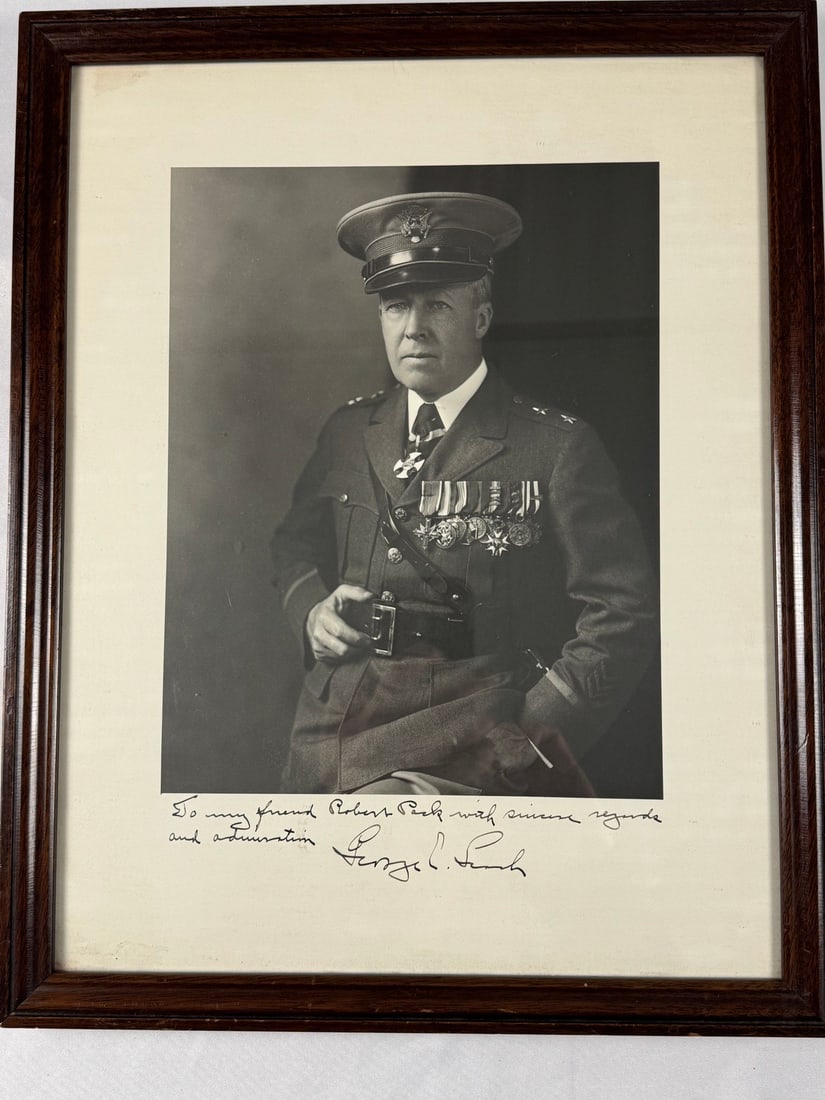
Exceptionally scarce autograph. 15×12 Framed portrait with personal inscription. George Emerson Leach was born on July 14, 1876, in Cedar Rapids, Iowa, to Mary Leach, originally from Michigan, and William Leach, a native of New Hampshire. William Leach studied at the University of Vermont, later relocating to Minnesota where he earned his law credentials. He distinguished himself during the Civil War, notably at the Battle of Bull Run as a member of the First Minnesota Infantry Regiment. Following the war, he held positions in the Iowa Legislature, served on the Iowa Superior Court, and was elected mayor of Cedar Rapids.In 1884, the Leach family settled in Minneapolis, Minnesota. George graduated from Central High School and later attended law school at the University of Minnesota, receiving his degree in 1897. Over the next several years, he explored a variety of professions including insurance, banking, and grain inspection.Leach’s military career began in 1905 when he joined the Minnesota National Guard, starting in Battery B of the First Minnesota Artillery. He rose steadily through the ranks, attaining the rank of Captain by 1908. In 1916, he was deployed to the Mexican border during the conflict with Pancho Villa, serving as a Major in the First Minnesota Field Artillery Regiment. By the end of that mission, he had been promoted to Colonel of the regiment.With America’s entry into World War I, his regiment was reorganized as the 151st Field Artillery and became part of the legendary 42nd “Rainbow” Division. Leach and his men saw their first front-line service in February 1918. In March, his unit engaged in heavy artillery exchanges, firing thousands of rounds and sustaining losses. Leach himself was wounded on March 19 during a German bombardment.One of the more poignant moments of the war came when Leach’s unit, during the Château-Thierry campaign, discovered the remains of Quentin Roosevelt, son of former President Theodore Roosevelt. The regiment later participated in key operations including the Saint-Mihiel and Meuse-Argonne Offensives. Leach remained in Europe with occupation forces and returned home in May 1919, having spent 19 months overseas.For his exemplary service, George Leach received several prestigious awards including the Distinguished Service Cross, the Distinguished Service Medal, the Purple Heart, and France’s Legion of Honor. He eventually attained the rank of Major General, and in 1934, was given command of the 34th Infantry Division.In civilian life, Leach returned to business in St. Paul, engaging in the insurance industry and founding new ventures. He served as Mayor of Minneapolis from 1921 to 1929 and again from 1937 to 1941. In 1924, he managed the U.S. Olympic Ski Team and was later honored by induction into the National Ski Hall of Fame. From 1931 to 1935, he was appointed Chief of the National Guard Bureau in Washington, D.C.A strong proponent of military preparedness and universal service, Leach left a legacy of civic and military leadership. He passed away in Los Angeles in 1955 at the age of 79 and was buried with full military honors at Fort Snelling National Cemetery, where his interment included a 13-gun salute and three artillery volleys.
Share this lot: